
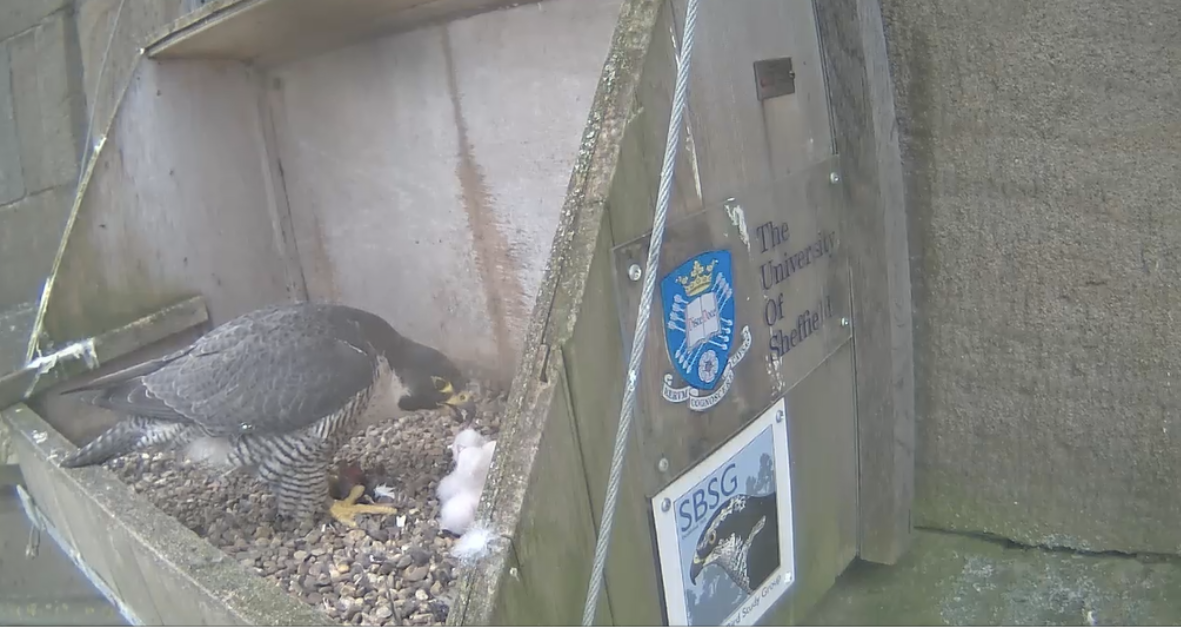
The wait is over for four Peregrine Falcon eggs to hatch at an artificial nesting spot just above St George’s Church, with the chicks making an appearance this afternoon.
Last month, birdwatchers across the country tuned in to observe as a Peregrine Falcon laid her fourth – and final – egg live on camera.
This event marked the beginning of the incubation period, where the Peregrine sits on her eggs until first hatch.
In a blog post published to the Sheffield Peregrines website at the end of March, Chris Greenwood, a member of the Sheffield Bird Study Group, explained that Peregrine pairs tend to lay eggs in sets of four, making it improbable that the Peregrine would lay another.
This year, the falcon sat on her eggs for a total of 33 days, compared to the typical incubation period of between 30 and 32 days.
In the meantime, Sheffield’s birdwatching community will have been watching closely, hoping to catch a glimpse of the long-awaited Peregrine chicks.
(Credit: University of Sheffield)
The nesting platform at St George’s was installed by the University of Sheffield in 2012, and has since become a crucial site for Peregrine Falcon breeding, known to bird enthusiasts throughout the city and beyond.
The nest was erected in an effort to help boost the number of Peregrine Falcons in the UK, which had dropped drastically due to persecution and pesticide poisoning.
Today, Peregrine Falcons have been placed on the RSPB’s Green List, featuring birds that are of the least conservation concern.
21-year-old Louis Temple, a fourth-year Zoology student at the University of Sheffield, spoke of the challenges faced by Peregrine Falcon numbers over the last century and expressed his excitement at the prospect of breeding pairs raising a “new generation”.
“It’s especially encouraging in a city environment like Sheffield, where wildlife can struggle to live alongside people and infrastructure,” he said.
Follow the rest of the breeding season on the University of Sheffield’s 24/7 livestream.