One in four people in Sheffield is living in poverty and the city has one of the highest rates of child poverty in the UK.
The South Yorkshire city has some of the poorest neighbourhoods in the country with 31.2% of children experiencing poverty compared to a national average of 18.9%.
Martin McKervey, civic and business commissioner for the Sheffield Poverty Truth Commission (SPTC), said: “Those statistics anger me. I don’t feel a sense of frustration, I feel anger and agitation, that in 2026, we live in a city that seems to think this is acceptable and normal.
“At the commission, there is a very singular focus, we have to do something about this.”
In a bid to help those in need, the SPTC has published a new report recommending public services use simpler language when offering support to residents who are struggling financially.
The brown envelope code focuses on clear communication around bills, benefits, debts, and services, to combat the intimidation and confusion many in poverty can feel.
“We are creating hope and helping to make Sheffield a better place,” said Mr McKervey.
The recommendations come after a year and a half of discussions, where community commissioners with lived experience of poverty told of their struggles in accessing information and support.
The SPTC have become a key voice in how the council makes decisions around poverty after being regularly invited to Sheffield City Council meetings.
What are Poverty Truth Commissions?
Poverty Truth Commissions (PTCs) are community-led initiatives designed to tackle poverty by bringing together people with lived experience of poverty and local decision makers.
The motto that underpins PTCs is, “nothing about us, without us, is for us”.
PTCs are split up into regional poverty truth commissions, with the SPTC established in September 2024.
The first meeting brought together community commissioners, people who have faced the struggle of poverty, and civic commissioners, who have had influential roles within South Yorkshire.
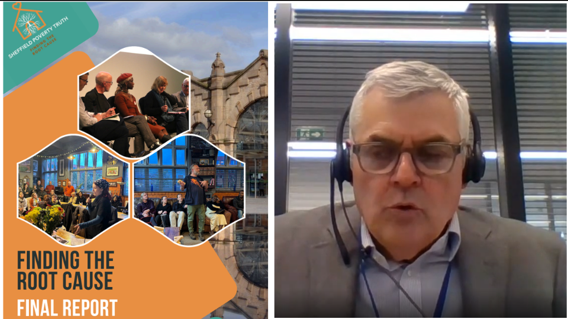
The SPTC’s report, entitled Finding the Root Cause, was brought forward for discussion in February this year, and has already impacted policy implementation by Sheffield City Council.
When the Council introduced £10m for the Crisis and Resilience Fund (CRF) over the next three years, the report was credited with “highlighting the need for more compassionate, dignified, and person-centred services”.
Part of the CRF was a ‘no wrong doors’ model, allowing residents to get help online, by phone, or through trusted places such as Family Hubs, a policy introduced to create person-centred support.
What else does the SPTC focus on?
As well as recommending changes to the system in place for people living in poverty to get help, Finding the Root Cause focuses on poverty-proofing education, and prioritising the impact poverty can have on people’s mental health.
Finding the Root Cause says: “There are strong societal forces that trap people in poverty, including the availability of secure work, housing costs and government choices on benefit levels and eligibility. Yet, poverty is not inevitable. We know that policy decisions can and do influence poverty rates.”
Through recommending city-wide implementation of the brown envelope code, and influencing the council in replacing the former Household Support Fund (HSF) with the CRF, they are going some way to changing how poverty is discussed in Sheffield.
Mr McKervey said: “This commission has been one of the most rewarding and important things I have ever taken part in.
“We take our lanyards off at the door, there is no power in this commission. The community commissioners are at the centre of everything we do, because that lived experience must be the leading voice, the determining voice in all that we discuss.”
However, Mr McKervey acknowledges poverty is a deep-rooted issue with no short-term fix, and change will not happen overnight.
“What our commission cannot be is just a conversation over a year, we all have a good time together, and then we all disappear into the ether,” he said.
“We must be very comfortable in the fact this is a long-term project, there is no quick fix in this.”
Inequality is another factor that plagues the city. If you were to take the 83 bus route from Fulwood in the west to Burngreave in the east, which takes approximately 40 minutes, female life expectancy drops by ten years from 87 to 77.
Douglas Johnson, Green councillor for City ward, sat on the Strategy and Resources Policy Committee that heard the SPTC’s report in February.
He said: “The SPTC was a chance to get under the skin of what poverty really looks like in Sheffield and how it holds the city back. It was also a chance for all the sectors in Sheffield – public, private, and voluntary – to think how they can help tackle poverty, or alternatively, how their actions make things worse for people on very low incomes.
“Everyone, especially in official bodies like the council and NHS, can help address poverty and hardship by being kind and trying to understand where individual people are coming from when they use our services.”
Video: What does Sheffield think of poverty in the city?
How urgent is the need to address poverty in Sheffield?
Sheffield residents agree that poverty is a prominent feature of life in the city.
Dr Lisa Thorley, 48, from Woodseats, said: “There’s a lot of evident poverty in Sheffield, with many ghettoised areas.
“If you look at Eccy (Ecclesall) Road and London Road, they’re nearly parallel, but economically they’re worlds apart.”
She believes the city is mainly divided along the lines of race. Her daughter was the only dual heritage student at her primary school in an affluent area of south Sheffield, while poorer parts of the city are often much more ethnically diverse.
Alessandro Leonardi, 38, a senior lecturer at the University of Sheffield, said: “In Sheffield, you just cross a neighbourhood and everything is different. In parts of the city centre there is so much homelessness.”
He said he was part of a family looking to adopt, and many of the children looking for adoption in Sheffield are from low-income areas.
What do residents think should be done?
Residents were sceptical about what could be done to combat poverty in Sheffield.
Dr Thorley said: “There’s not enough funding at the local level. There have been decades and decades of austerity and mismanagement.
“It’s good that the council is investing in the city centre, but some of it is still an absolute dump.”
Simon Clifford-Smith, 79, who is now retired, agreed that funding on the council level was a major issue.
He said: “The council doesn’t get paid enough to do what they want to do. There’s lots of social services that the council is trying to provide and they can’t because they don’t have the funds.”
Asked about one of the SPTC’s tenets, poverty-proofing education, Danijel Filipovic, 35, said: “I think more accessible learning and development could help, in England there is a big difference between who can afford to study and who can’t.”
Everyone who spoke to Sheffield Wire agreed that poverty was a pervasive feature in Sheffield.
Over a year and a half of discussions and research, the Sheffield Poverty Truth Commission has worked to put people with lived experience’s voices at the forefront to change how poverty is understood on a council and government level.