
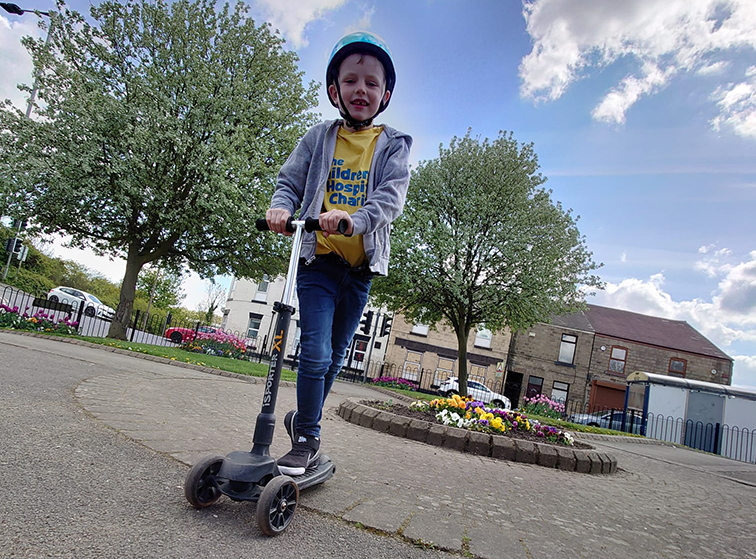
Six-year-old with diabetes embarks on scooter marathon to raise money for Sheffield Children’s Hospital
A six-year-old boy with type 1 diabetes is completing a marathon on his scooter to raise money for the hospital that looks after him.
Tommy, from Rotherham, has already met his target to raise £500 for The Children’s Hospital Charity, despite having eight miles of his 26-mile journey left to go.
The primary school student has been scootering over seven days and is set to complete his challenge in Weston Park this Saturday, in view of Sheffield Children’s Hospital.
After being critically ill with diabetic ketoacidosis, Tommy was diagnosed with type 1 diabetes at just two years-old.
He’s since spent a significant amount of time at Sheffield Children’s Hospital, for regular outpatient visits, in-patient stays and other procedures.
He said: “The hospital looks after me so well, now I want to do something for them.”
Though exercising is difficult due to the need to regulate his blood sugar levels, Tommy has kept the hospital and his fellow patients at the forefront of his mind while scootering, according to his mother, Jessica.
 Jessica said: “It has been difficult at times, but that’s made it a little bit more special: he’s just pushed on and got through it."
She added: “We’re really proud of him. But we’re proud of him anyway: at only six years old, he’s had to go through quite a lot of things that most people don’t even by the time they’re an adult.
“He just seems to face everything with so much positivity and courage.”
To celebrate the end of his effort, Tommy will host a final fundraiser party for friends and family at his home.
His mother said Tommy was “over the moon” with the donations he had received so far.
The scooter marathon is not the first of Tommy’s fundraising efforts. In 2020, he raised over £700 by hosting a coffee morning with his school friend.
Lucy Cain, Community Fundraising Officer at The Children’s Hospital Charity, said: “We would like to say a huge thank you to Tommy for taking on this amazing scooter challenge for Sheffield Children’s.
"We were all moved to hear of his gratitude for his care at our hospital and he’s raised such a fantastic amount already!
"Thank you Tommy and best of luck with those last few miles!”
To donate and find out more, visit: https://www.justgiving.com/fundraising/tommylscooter
Jessica said: “It has been difficult at times, but that’s made it a little bit more special: he’s just pushed on and got through it."
She added: “We’re really proud of him. But we’re proud of him anyway: at only six years old, he’s had to go through quite a lot of things that most people don’t even by the time they’re an adult.
“He just seems to face everything with so much positivity and courage.”
To celebrate the end of his effort, Tommy will host a final fundraiser party for friends and family at his home.
His mother said Tommy was “over the moon” with the donations he had received so far.
The scooter marathon is not the first of Tommy’s fundraising efforts. In 2020, he raised over £700 by hosting a coffee morning with his school friend.
Lucy Cain, Community Fundraising Officer at The Children’s Hospital Charity, said: “We would like to say a huge thank you to Tommy for taking on this amazing scooter challenge for Sheffield Children’s.
"We were all moved to hear of his gratitude for his care at our hospital and he’s raised such a fantastic amount already!
"Thank you Tommy and best of luck with those last few miles!”
To donate and find out more, visit: https://www.justgiving.com/fundraising/tommylscooter
Local Elections: “It really is the cost of living election,” says Sheffield Labour candidate
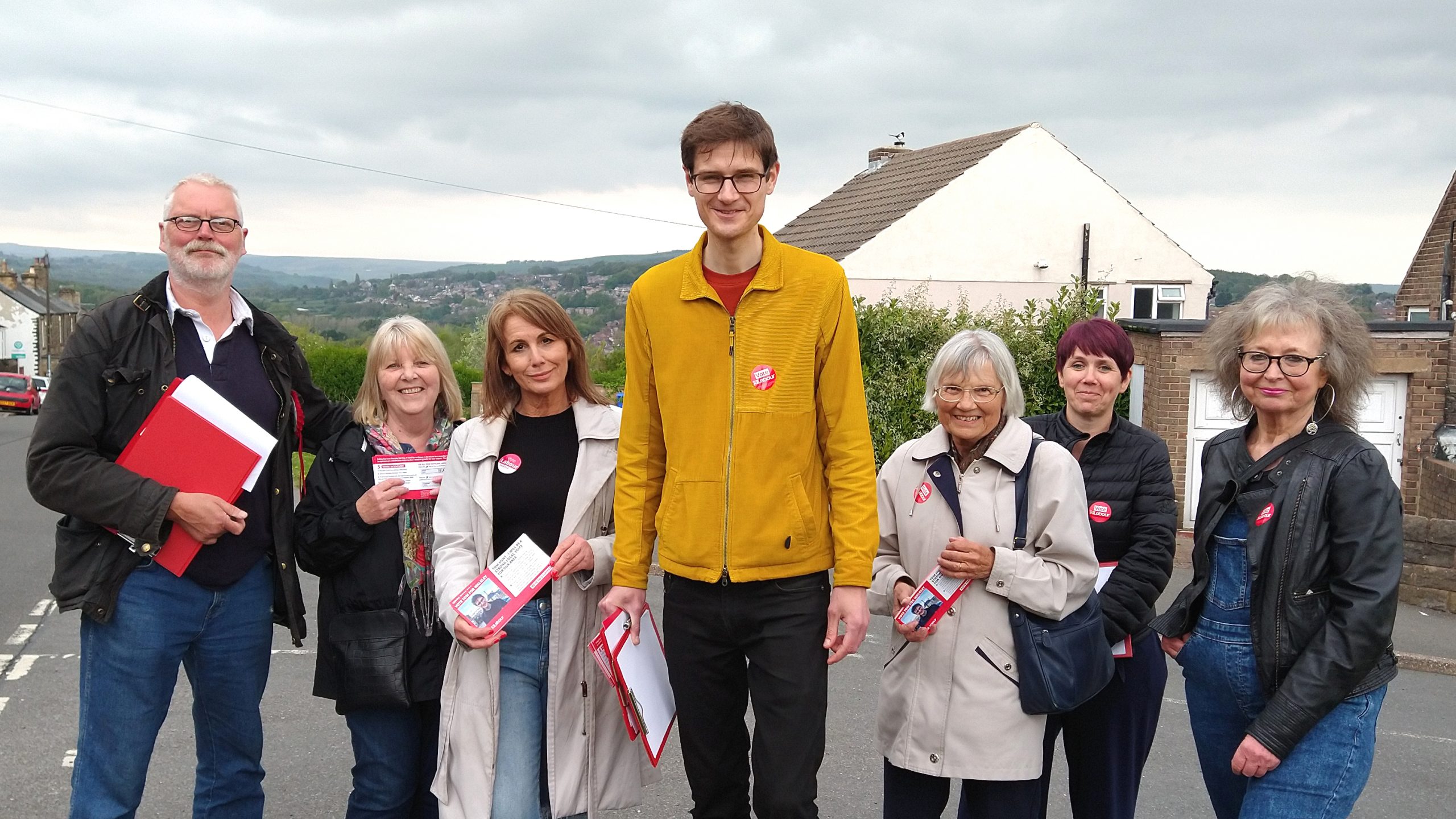
A Sheffield Labour Party candidate has drawn attention to rising inflation and energy bills in his campaign, telling Sheffield Wire "it really is the cost of living election". Tom Hunt is running for election in the Walkley ward - covering Langsett, Netherthorpe, Upperthorpe, Walkley, and Walkley Bank. Mr Hunt, who lives in Upperthorpe and has lived in Sheffield for 15 years, said it is "all to play for" in the ward after the Green Party gained a seat from Labour in last year's local elections. In 2018, when the seat Mr Hunt is running for was last up for grabs, Labour's Cllr Neale Gibson held the seat with a majority of 723 votes.

Tom Hunt (right) canvassing with campaigners and MP Paul Blomfield (Credit: Walkley Labour)
With Labour up to 13 points ahead in the polls, according to Survation, and expected to make gains across the country, Tom Hunt was reluctant to estimate how successful his Party would be. "I am not taking anything at all for granted and I am taking as much time as possible to speak to as many people as possible, and I will be doing that right up to 10pm on Thursday night," said Mr Hunt, who is Chair of Trustees at the Zest charity in Upperthorpe. Also running in the Walkley ward is the Green Party's Logan Robin, Evelyn Millward from the Conservatives, Liberal Democrat David Pallot, Victoria Kensdale of the Women's Equality Party, and Alexander Helie from the Trade Unionist and Socialist Coalition.It was brilliant to be joined by @Ed_Miliband in Walkley today to talk to people about Labour's plan for a greener economy and help to tackle rising energy bills. I'm thrilled to have his endorsement pic.twitter.com/fVrZol8070
— Tom Hunt (@tomhunt100) April 30, 2022

Former Sheffield United favourite David Brooks given cancer all-clear
Ex-Sheffield United star David Brooks says he is "cancer free" after a battle with Hodgkin's Lymphoma. The 24-year-old Wales international has not played for his current club Bournemouth since his diagnosis in October. In a statement released on his personal Twitter account, Brooks said: "I am delighted to say my treatment has been successful and I can now say that I have been given the all clear and am now cancer free." "Those words feel incredible to say and I am so thankful for all of your messages and good wishes, these really helped me through the tough times," he added.
— David Brooks (@DRBrooks15) May 3, 2022Making his first team debut for Sheffield United in 2016, Brooks made 39 appearances for the Blades before transferring to Bournemouth for £11.5m in 2018. Capped 21 times by his country, Brooks made three outings for Wales at the delayed EURO 2020 finals last summer. Brooks spoke of his desire to get back to doing what he does best as soon as possible. "I am determined to work my hardest over the months ahead and I can't wait to be back out there playing in front of you on the pitch again in the not so distant future," he declared.

Sheffield Wednesday financial losses divide experts
Football finance experts are divided over whether the announcement of significant losses for the Hillsborough-based club in the 2020/21 season represents a ‘step in the right direction’ or is ‘alarming’. The publication of Wednesday’s annual accounts may have given fans cause for concern this morning, with headlines from the report indicating losses of half-a-million pounds per week and an increase in overall losses to more than £25million. Kieran Maguire, an expert in football club finance and author of the Price of Football, said of the release this afternoon: “The headline numbers are quite alarming in the sense that the club lost half a million pounds a week as well as the fact that wages are more than double the amount of money the club managed to generate through revenue. “That's for a club that ended up being relegated so it couldn't even say ‘Well we overspent because we were gambling we were trying to achieve promotion’. So that is a cause for concern.” The account release showed the wages bill at the club had decreased by £9m with the departure of high-cost players such as Steven Fletcher and Kieran Lee. In addition, the accounts represent a season in which all football was played behind closed doors due to the pandemic and only show an increase in total yearly losses of £1m on the previous year. Dr Dan Plumley, Senior Lecturer in Sport Business Management at Sheffield Hallam University, said there were significant positives to take from the report. “It’s important to remember that these accounts are for the 2020/21 season,” said Dr Plumley. “We are still seeing the impact of Covid so things are going to get worse before they get better. There was always going to be a drop in turnover, but it’s not necessarily as bad as it looks. “With the wage bill coming down it is definitely a step in the right direction.” Sheffield Wednesday are due to play the first leg of their play-off semi-finals against Sunderland on Friday and promotion could mean a boost to the club’s financial viability.

Owls' boss Darren Moore. Credit: Derby Telegraph.

Blanket ban on primary school exclusions “too simplistic” says headteacher
Some parents and teachers are criticising a proposed ban on primary school expulsions, saying that sometimes it takes being expelled for a child to get the help they need.
The Commission on Young Lives proposed an end to “exclusion culture” in a report by a group of experts published on April 29. The report noted a rise in expulsions in recent years and the damaging effect being expelled can have on a child. For example, 59% of permanently expelled children have been cautioned or sentenced for an offence.
The report, ‘All Together Now’, calls for a ban on primary school expulsions from 2026. It also wants additional provisions to support students who are struggling in school. It draws attention to the fact that children of an ethnic minority or with special educational needs are disproportionately excluded.
At five years old, Kathryn Bickerstaffe’s son, Leon, was excluded from school and was assessed for autism within six months. He was diagnosed with Asperger’s Syndrome and then went to a special needs school. They worked with him to rebuild his self-esteem, and over time he went back into the mainstream primary school. The entire process took about a year, which Kathryn feels is drastically better than the current “underfunded, failing system”.
 Kathryn, from Manchester, said she feels some teachers see children with special needs as all the same, as at her son’s first primary school.
She said: “They would tell me that he wasn’t allowed into school for trips because of his behaviour. Three other pupils were stopped from going on the trip too, but they were allowed to come into school. I was told that my son had to stay at home. I felt this was discriminatory.”
Kathryn said she knew the school couldn’t meet his needs but felt his exclusion was badly handled. They phoned her at work to tell her he was being excluded and, after visiting the school, she left feeling “patronized and angry.”
However, looking back, she said she appreciated how difficult it must have been for them and thinks being expelled was much better than keeping her son at the wrong school in the name of inclusion.
He was later sent to a special needs school: “He was lucky because he went to an amazing special school who worked with him and helped him. They fully understood his needs. They also supported him back into a different mainstream primary school.”
Kathryn, from Manchester, said she feels some teachers see children with special needs as all the same, as at her son’s first primary school.
She said: “They would tell me that he wasn’t allowed into school for trips because of his behaviour. Three other pupils were stopped from going on the trip too, but they were allowed to come into school. I was told that my son had to stay at home. I felt this was discriminatory.”
Kathryn said she knew the school couldn’t meet his needs but felt his exclusion was badly handled. They phoned her at work to tell her he was being excluded and, after visiting the school, she left feeling “patronized and angry.”
However, looking back, she said she appreciated how difficult it must have been for them and thinks being expelled was much better than keeping her son at the wrong school in the name of inclusion.
He was later sent to a special needs school: “He was lucky because he went to an amazing special school who worked with him and helped him. They fully understood his needs. They also supported him back into a different mainstream primary school.”
 “I wish that every child had the support that my son received.”
Graham Chatterley is a former headteacher who now advises teachers on how to help children with special needs. He also has two children with extra behavioural needs in school himself.
“I wish that every child had the support that my son received.”
Graham Chatterley is a former headteacher who now advises teachers on how to help children with special needs. He also has two children with extra behavioural needs in school himself.
 He said that while the ban on primary school exclusions was good in theory, it wasn't realistic and was too simplistic.
“It becomes a very binary debate. One side is we want to ban exclusions, and the other side is those children who bring a knife to school.”
Graham said that it was far too easy to jump straight to expulsion: “The rate of exclusions is far too high. We need to do better. There is too much zero tolerance, and not enough incidents are given the context they need.”
He said a blanket ban was “too simplistic for a very complex area. People want it to be simple, but it isn’t. I don’t think that discussion about banning all exclusions in primary schools is helpful.
“We need to reduce exclusions for persistent disruptive behaviour, not for big incidents like assault. Those need to be dealt with differently.”
One of the things the report mentions is better support for children with behavioural issues, and he said this is a great thing to look at.
“When you scratch beneath the surface, you find that there is trauma, attachment issues, ADHD, and sensory processing…there are many underlying and undiagnosed things. The way you get a diagnosis is that the children need to fit into boxes. Children who have complex needs and a mix of different things often they don’t fit into those boxes. It is hard to get a diagnosis for these, and they are expressed through behaviour in a negative way," said Graham.
The bulk of permanent expulsions are for persistent disruptive behaviour, accounting for 34% of expulsions from school.
He said children need to be taught a better way of behaving, and teachers should show them how to learn from their mistakes in a constructive way.
“When it comes to these rigid systems, the behavioural mistakes have a consequence of expulsion, and you don’t have the child to do all the teaching, to learn a better way.”
Graham acknowledged that sometimes expulsion is needed: “I have worked with many good, very inclusive headteachers where exclusion is a last resort, but it becomes the only thing they can do to get the things required for that young person.”
Speaking from a parent’s perspective, he said it can be a relief when a child gets the help they need: “You just spend your life fighting all the time, and for some, it is a relief, in the end, to get the child in a provision where they get the support they need.”
However, he explained that being expelled causes “so much damage to self-esteem and wellbeing.”
While Kathryn’s son managed to get back into the central primary school, Graham said the success in turning children around and getting them back into mainstream school isn’t what it should be.
Both Graham and Kathryn emphasize the lack of school resources and staff skills, and Graham said: “The system’s funding is absolutely scandalous.”
Anne Longfield, Chair of the Commission on Young Lives, who led the report suggesting a ban on exclusions, said: “These are the young people at the sharp end of an education system which has not always prioritized the needs of vulnerable children, and one that I believe could and should be transformed to ensure all children can succeed.”
Local Government Association (LGA) research reveals a funding gap of almost £500 million for council funding for children with additional needs in education. The government has issued additional funding to fill this gap, but the LGA says this isn’t enough.
Funding pressures on mainstream schools, a rise in the number of pupils, and overwhelmed staff have led to schools struggling to provide children with special needs the help they need and see expulsion as the only way.
He said that while the ban on primary school exclusions was good in theory, it wasn't realistic and was too simplistic.
“It becomes a very binary debate. One side is we want to ban exclusions, and the other side is those children who bring a knife to school.”
Graham said that it was far too easy to jump straight to expulsion: “The rate of exclusions is far too high. We need to do better. There is too much zero tolerance, and not enough incidents are given the context they need.”
He said a blanket ban was “too simplistic for a very complex area. People want it to be simple, but it isn’t. I don’t think that discussion about banning all exclusions in primary schools is helpful.
“We need to reduce exclusions for persistent disruptive behaviour, not for big incidents like assault. Those need to be dealt with differently.”
One of the things the report mentions is better support for children with behavioural issues, and he said this is a great thing to look at.
“When you scratch beneath the surface, you find that there is trauma, attachment issues, ADHD, and sensory processing…there are many underlying and undiagnosed things. The way you get a diagnosis is that the children need to fit into boxes. Children who have complex needs and a mix of different things often they don’t fit into those boxes. It is hard to get a diagnosis for these, and they are expressed through behaviour in a negative way," said Graham.
The bulk of permanent expulsions are for persistent disruptive behaviour, accounting for 34% of expulsions from school.
He said children need to be taught a better way of behaving, and teachers should show them how to learn from their mistakes in a constructive way.
“When it comes to these rigid systems, the behavioural mistakes have a consequence of expulsion, and you don’t have the child to do all the teaching, to learn a better way.”
Graham acknowledged that sometimes expulsion is needed: “I have worked with many good, very inclusive headteachers where exclusion is a last resort, but it becomes the only thing they can do to get the things required for that young person.”
Speaking from a parent’s perspective, he said it can be a relief when a child gets the help they need: “You just spend your life fighting all the time, and for some, it is a relief, in the end, to get the child in a provision where they get the support they need.”
However, he explained that being expelled causes “so much damage to self-esteem and wellbeing.”
While Kathryn’s son managed to get back into the central primary school, Graham said the success in turning children around and getting them back into mainstream school isn’t what it should be.
Both Graham and Kathryn emphasize the lack of school resources and staff skills, and Graham said: “The system’s funding is absolutely scandalous.”
Anne Longfield, Chair of the Commission on Young Lives, who led the report suggesting a ban on exclusions, said: “These are the young people at the sharp end of an education system which has not always prioritized the needs of vulnerable children, and one that I believe could and should be transformed to ensure all children can succeed.”
Local Government Association (LGA) research reveals a funding gap of almost £500 million for council funding for children with additional needs in education. The government has issued additional funding to fill this gap, but the LGA says this isn’t enough.
Funding pressures on mainstream schools, a rise in the number of pupils, and overwhelmed staff have led to schools struggling to provide children with special needs the help they need and see expulsion as the only way.
Sheffield stands against conversion therapy at City Hall protest
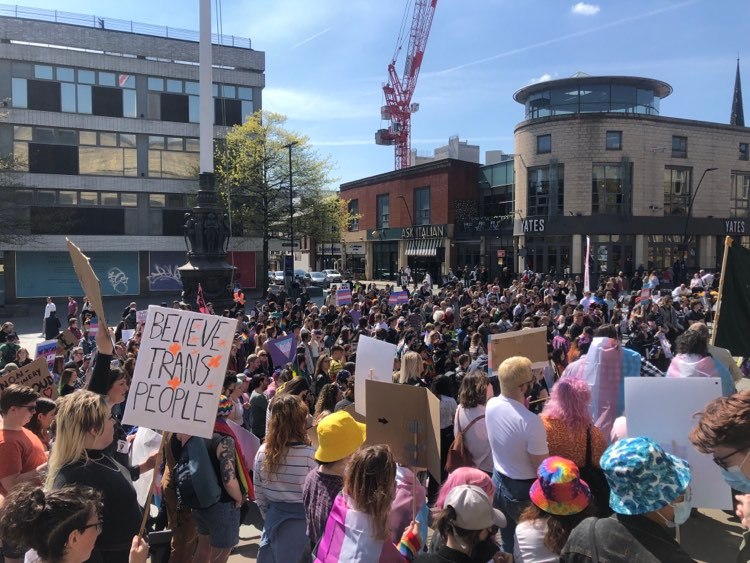
Around 200 protesters gathered in Sheffield City Centre on Saturday to protest against the UK government outlawing conversion therapy for Gay, Lesbian, and Bisexual people - but not Transgender people. The protest was organised by the Sheffield Against Conversion Therapy group, and chants and speakers were heard from outside the City Hall between 11am-12pm. "The people united, will never be divided," was a chant head on the day which echoed the sentiments of those standing up for trans rights. Blake May, 24, an attendee said: "It was the biggest protest I've ever seen in Sheffield. It's great to see so many people standing up for the people that often aren't given a voice."

There was a sea of trans pride flags at the protest.
Prime minister Boris Johnson has described gay conversion therapy as "abhorrent" but has said "there are complexities and sensitivities when you move from the area of sexuality to the question of gender." He argued that we should simply show "love and support" to those who transition.Hundreds of Sheffielders showed up for the conversion “therapy” protest today - folks of all ages and genders, LGBTQI and allies. Barkers Pool looked beautiful. Thanks to the organisers for holding a safe space, amazing to see how #Sheffield showed up 🏳️⚧️ 🌈 ☀️ ✊ https://t.co/3LBINGeQml
— Melanie Iredale (@Melanie_Iredale) April 30, 2022

A protestor's sign at the protest on Saturday.
Barnsley manager leaves due to club’s relegation
Poya Asbagi and his assistant Ferran Sibila left the club on Sunday following a mutual decision between them and Barnsley Chief Executive Khaled El-Ahmad. The talk came about when Barnsley dropped league tables on Friday night after their 2-1 defeat against Huddersfield. The 36-year-old was appointed to Oakwell in November 2021. He told the club website: " I want to thank everybody at Oakwell for their time and efforts over the last months, this of course includes players, fans and staff. It’s been a real privilege to work in Barnsley and I wish everybody all the very best for the upcoming seasons." El-Ahmad added: " On behalf of Barnsley Football Club, I would like to thank both Poya and Ferran for their hard work and professionalism during a difficult time. Our search for a new coach has already started and an announcement will follow once that process is concluded.” Martin Devaney, along with Tom Harban and Jo Laumann, will be in charge of the first team for the rest of the 21/22 season. In a press conference held at Barnsley today, Devaney stated: "The last 24 hours have been manic. It is always disappointing to see a colleague lose their job. I have been given the responsibility now for the next few games and I'm looking forward to it." What do the people of Barnsley think?

‘The scene will adapt’: Sheffield music scene will Get Together and be louder than ever for the return of eclectic city centre festival
The fate of the Leadmill remains unknown but Sheffield music scenesters will sing back in solidarity at a grassroots festival this bank holiday weekend. Get Together has six stages over the University of Sheffield’s campus After a huge success last Summer, Get Together is back this Sunday 1 for the May bank holiday. Kieran Crosby, 33, who promotes and organises the festival said: “There truly is something for everyone. “I urge anyone to come down and take a look at the musical magic. “We have a free entry section ‘under the bridge’ for anyone who wants some part of the action. “Our ethos is good vibes only.” Doors open at midday and live music is on until 11pm. With a free after party at Sydney and Matilda for wristband-holders, festival-goers can keep going until 4am. Get Together is spread out across six University of Sheffield venues. Grassroots indie artists such as Squid, Wax Works and Oh Papa are just three of the 38 acts on the line-up. The promoter added it's a steppingstone for lesser-known bands to gain fans and get booked for bigger festivals. Accompanying the music madness, an artist will draw a live mural under the bridge and punters can grab a pint at the Student Union’s Beer Festival. Revellers won’t go hungry as Icarus and Apollo world food, Nether Edge pizza company and Shoot the Bull will be serving up a storm. There will also be plenty of bars for partiers to cause some bank holiday mayhem. Mr Crosby added: “We have a cross-section of quality music for music lovers of all ages. “My favourite part is the unplanned, unpredictable things that happen. “Last year the band, Dream Wife, brought their gran on stage to sing a song.” Despite the precarity of the Leadmill’s future, the music promoter is optimistic that the scene will continue to thrive. He said: “In the last few years we have gone from nothing to so much happening musically in the city. “I’m excited about how the new ecosystem is growing and we are progressing in the right direction.” The Blinders an indie-rock band, are getting ready to return to perform at the festival. With Doncaster roots, the band are now based in Manchester but don’t define themselves geographically. With so many memories of the bedrock of Sheffield’s sound, Thomas Haywood, the band’s frontman, is unsure what the future holds. “It is the cornerstone of Sheffield music, but as a scene we are resilient. I am sure we will adapt,” explains the artist. The band’s frontman said metropolitan festivals such as Get Together give grassroots band the chance to connect with fans. He said: “all of the Donny lot will be there, including my mum, Jane, who will be cheering from the crowd. “Sheffield shows are usually rowdy, hopefully people won’t have forgotten about us!” “We go to every show with the same mentality but we love metropolitan festivals like Get Together because most people there are real music fans,” explains Tom.

April 25th: Snooker summary
Scotland's John Higgins remains on course for a first Crucible crown in 11 years, after beating Thailand’s Noppon Saengkham 13-7. Today’s victory sees Higgins through to the 16th Crucible quarter-final of his career. Higgins came into this afternoon with a 11-5 advantage. He then stepped up with a break of 90 to get over the line and confirm his 13-7 win. He now awaits either Jack Lisowski or Neil Robertson in the quarter-finals. England's Stuart Bingham pulled away from 8-8 to beat Kyren Wilson 13-9 in the second round of the Betfred World Championship. More to follow.
New exhibition opens in Fargate showcasing talent from disabled artists
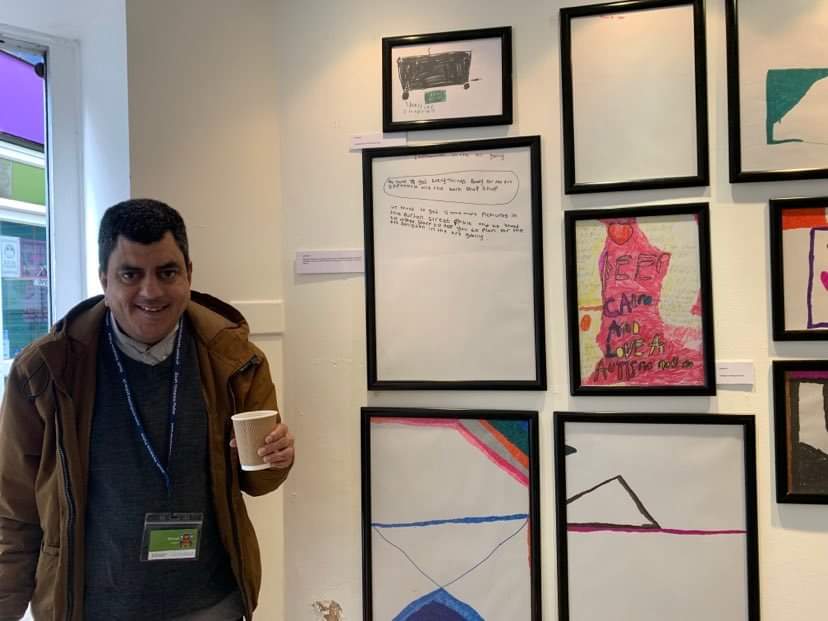
An exhibition showcasing sculptures, paintings and drawings made by artists with a range of disabilities has opened in Chapel Gate, Fargate. The exhibition, put on by Burton Street Foundation, supports people with additional needs, with 100% of the proceeds going to the artists themselves.

An Artists work

Adnan's work
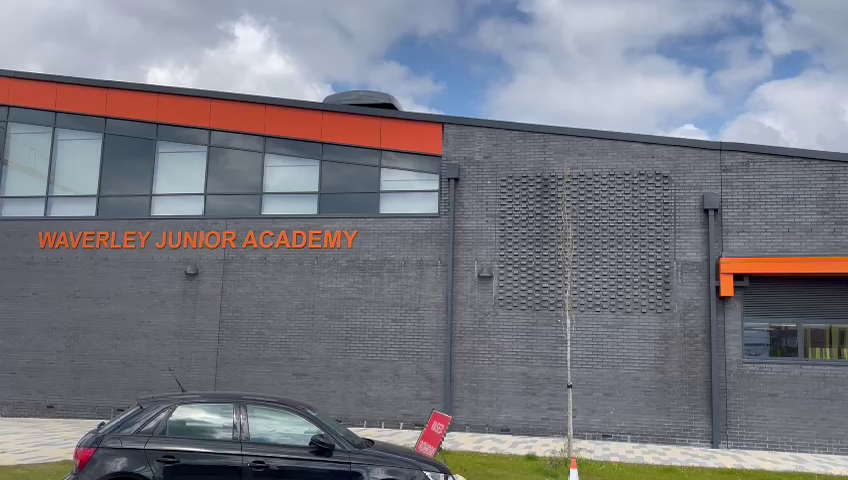
Rotherham parents having “sleepless nights” after children living within catchment not offered places at Waverley Junior Academy
Rotherham parents are devastated after 21 children living within the catchment were not offered a place at Waverley Junior Academy. Rotherham Council use a national formula to calculate the number of places likely to be required in each area, and they originally thought that they had over provided the number of places at the school by over 25%. However, the new Waverley housing development has far exceeded forecasted demand, particularly for infant and pre school age groups.
Waverley Junior Academy is one of two primary schools planned for the Waverley development. As of February 2022, there were 1,354 houses occupied on the Waverley estate which, applying the nationally recognised formula for calculating school places, should generate a pupil yield of around 38 per year group.
The developer met their obligation for Waverley Junior Academy to accommodate 60 children which, typically, would be sufficient to meet demand for 2,000 homes. But an unusually high number of children are living at the Waverley development which means exceeded demand, with around 60-90 children living in the catchment area.
Mum-of-two and Waverley estate resident Bethany McNeil, said that her eldest daughter being placed at a school two miles away is "causing me sleepless nights." Ms McNeil continues that "she knows its not the developers fault but when we moved here we were sold the idea of there being a school" adding that she's "devastated we have to do this to her" when speaking of telling her daughter Darcy. Rotherham Council's Assistant Director for Education and Inclusion, Nathan Heath, said that 95.3% of children in Rotherham have been offered a place at their first choice Primary or Junior School. Mr Heath also said that In light of the unprecedented demand they are speaking to the developer to review agreements in place but that sadly any extra capacity this may create won't be in place in time for children starting school in September. Mr Heath adds that wherever possible they have been offered places at their second and third preference schools, all within two miles of their home. "It's in all our interests to ensure children have access to a good school close to home and we're sorry that, due to expectational circumstances, some Waverley parents have not been offered their first preference school" He continued. The MP for Rother Valley, Alexander Stafford, acknowledged that it is upsetting and distressing for parents. The MP said: "The council housing policy should be about developing sustainable communities, that is at the heart of national and local housing strategy. To allow a community the size of Waverley to develop without the services to support the population is a failure of Rotherham council's housing and planning policy. He continues "The issue of lack of amenities and services in Waverley is not new. The undoubted success of house building has not been matched by an appropriate level of services for the population. Besides the inadequate number of primary school spaces, there is no medical centre and the plans for a public transport hub seems to have vanished." Mr Stafford is holding a meeting tonight for parents to discuss the issue further and see what assistance can be provided for them. Any parent or carer whose child is refused a place at the academy can appeal against the decision not to offer a place, but appeals are heard by an independent panel and the decisions the panel make are legally binding on all parties.
South Yorkshire Police are urging people to come forward during National Stalking Awareness Week
This week is National Stalking Awareness week, which is dedicated to raising awareness of stalking and the effect it has. South Yorkshire Police are encouraging people to report any incidents of stalking or harassment, Superintendent Cherie Buttle, the force lead for stalking, said: “Stalking is a very serious offence, which can have a devastating impact on its victims- both physically and psychologically. As a force, we are committed to tackling this type of crime wherever we find it. There are many ways we can put a stop to this behaviour, including prison sentences, restraining orders and other penalties." Stalking is a pattern of fixated, unwanted and repetitive behaviour that causes the victim to fear for their safety. This includes a variety of behaviour such as unwanted contact in person, over the phone, online or on social media. It can involve threats, criminal damage, following or spying on someone. Currently, under the Protection from Harassment Act 1997, the maximum prison sentence for stalking involving fear of violence or serious distress is 10 years in custody. Stalking involving fear of violence or distress is a serious offence. It involves multiple occasions that cause a victim to fear violence against them or if there has been a substantial effect on their daily lives. South Yorkshire Police are working closely with the Suzy Lamplugh Trust, which campaigns to raise greater awareness of personal safety and stalking issues. Suzy Lamplugh Trust is an expert in lone-working and personal safety training, stalking training, as well as consultancy, campaigning, and support services. Violet Alvarez, from the Policy and Campaigns Team at the Suzy Lamplugh Trust, said there is a need for a better response to victims from those within the criminal justice system. "Independent Stalking Advocates are trained specialists who provide victims with expert advice and support during a period of crisis, often when the stalker’s behaviour is escalating and the response from the criminal justice system or other agencies fails to address it. "Despite Stalking Advocates providing an essential service to victims, the majority of respondents who experienced stalking in the UK were not supported by an advocate of any kind. Dedicated stalking support services have grown in recent years, but unfortunately, the demand for stalking advocates still far exceeds current capacity, with many victims left to navigate this traumatic and dangerous crime on their own." As a result, the trust are calling for £10 million a year in funding to be ring-fenced for stalking victims specifically. Violet Alvarez said that the trust found that victims who receive support from stalking advocates had a higher rate of reporting to the police and were more successful when pursuing legal action against their stalkers than the national rates. "This is compared with published rates for England and Wales where only one in 50 cases are reported, one in 435 stalkers are charged, one in 556 stalkers are prosecuted, and one in 1,000 stalkers are convicted. This demonstrates the vital need for more advocates to support victims." Supt Buttle said: “If you are suffering, or you think a loved one might be, please know that you are not alone. You do not have to put up with it. We are here to help and support you.