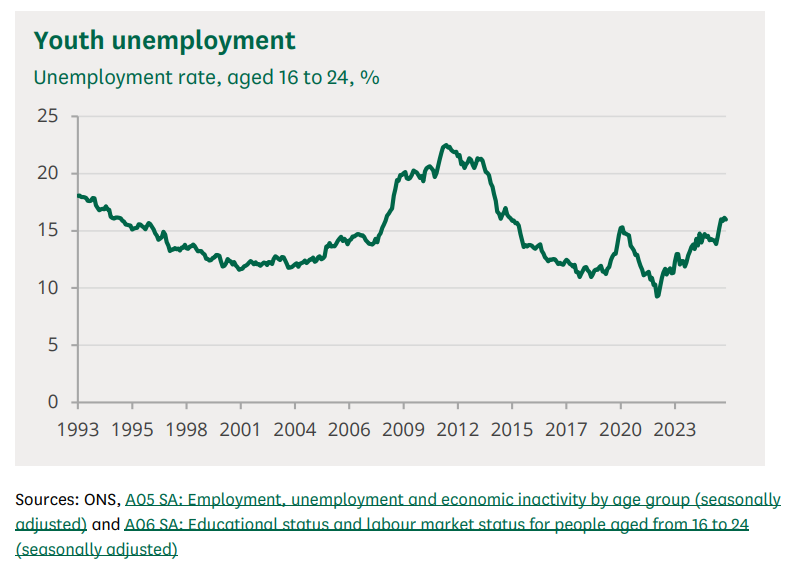
Almost 100,000 more 16-24 year olds in the UK were unemployed between November 2025 and January 2026, pushing the total to 732,000, new figures from the Office of National Statistics (ONS) show.
This means 16% of all young people in the UK were looking for work during the period – the highest level since 2015, and well above the national average of 5.2%.
Steve McIntosh, professor of economics at the University of Sheffield, believes that “rising costs of employing people” and the “sluggish performance of the economy” are causing businesses to “sit tight” and “avoid rash decisions” rather than take on new employees.
He said: “The lack of business confidence means new positions aren’t hiring. This affects business confidence.
“The confidence is feeding through into new hires, which affects people coming into the labour market looking for that first job in particular.”

Prof McIntosh highlights the rise in employer National Insurance contributions, as well as economic growth and productivity growth sitting “historically low levels for a long time now,” for the lack of business confidence.
On top of this, “AI is hitting entry level jobs – entry level jobs are taken more by young people,” he said.
The government also has plans to remove the discriminatory age bands on minimum wage, which would push up the cost of employing young people and risk further unemployment increases amongst those age groups.
In Sheffield, “the jobs which are available are advanced manufacturing, they are high skilled – degree level or at least advanced apprenticeships,” Prof McIntosh said.
Pressures from student finances are forcing students to compete for jobs with locals in areas such as hospitality.
South Yorkshire was 13th in the country for youth unemployment rates between 2014 and 2024, with an average rate of 14.2%, according to ONS data.
Chris Watson is the head Ascend, a Sheffield-based provision working with young people furthest away from employment, and has seen first-hand how the economy has changed.
He said: “We have seen an increase in numbers – we have got people who have got higher qualifications as well as those who have left school earlier.”
As more highly-qualified people are competing for lower-skilled jobs, there is a knock-on effect for people without formal qualifications, who in turn find it harder to get work.

Mr Watson said: “Lack of experience is definitely a massive barrier because there is high unemployment generally.
“If there is an opportunity to do a sandwich course or to do something where you get work experience, that is really positive.
“It is what I did, so that is what got me a job in engineering after I left university.”
Despite this, Mr Watson is keen to demonstrate that there are young people willing to work, and trying hard to find jobs.
He said: “I am amazed all the time by how resilient people are who are going through this.
“If you apply for 100 jobs and you are still going I think that shows real strength.
“People are saying ‘the younger generation are not wanting to work’ – that is definitively not the case, they are resilient and I am always amazed by the people I work with.”