Three quiet streets in Burngreave, North Sheffield, converge onto a small park. Here, lying just above the city centre in front of rows of houses, children ride bicycles with their friends, families talk with neighbours on front-door steps, and elderly couples walk hand-in-hand to and from local shops. But even on bright days like this, people avoid the park.
A Sheffield Wire reporter visited the area. The park is inhabited by piles of discarded, fly-tipped rubbish occupying lay-bys, bushes, and trees. Coated in litter at its clearest points and mounded with features of black plastic and brown cardboard at its worst,
While the area is often bustling with people, their shared community park is a persistent eye-sore; plagued by fly-tipping.
Day and night the area is open to exploitation by fly-tippers using the parkland as their personal dumping ground.
If there was a camera – a big camera – they wouldn’t come. My phone camera does not stop them for long.
Opposite the brand new NHS Spital Lane Health Centre, people living on the streets on the southern tip of Burngreave are reported in the media as being part of the “most targeted streets” for fly-tipping.
Reported by the Sheffield Star, through their 2024 Freedom of Information request to the Sheffield City Council, the individual fly-tipping statistics for these streets were revealed for 2024:
- Verdon Street, Burngreave: 90 fly-tipping incidents in 2024.
- Spital Lane, Burngreave: 102 fly-tipping incidents in 2024.
- Brunswick Road, Burngreave: 147 fly-tipping incidents in 2024 – the highest of any street in Sheffield.
While helpful in highlighting Sheffield’s most exploited streets, the Star’s article – screenshotting streets from Google Street View – puts an incorrect face to the crimes being committed.
Giving the impression it is the streets themselves, and the people on them, who are breaking Sheffield’s fly-tipping records, is not the correct picture.
Only when walking the streets is it realised the residents are the ones suffering.
As seen by our reporter, the sections of the streets used by residents – the paths, pavements, and roadways – were clean; likely a coordinated effort between the Council and residents. Bin bags tied to street fences, likely put up by the Sheffield City Council, were all full and being used. People were not seen littering and excessive rubbish was not seen on the roads – these were ordinary streets.
What was seen, however, were people avoiding the park at the end of their road.
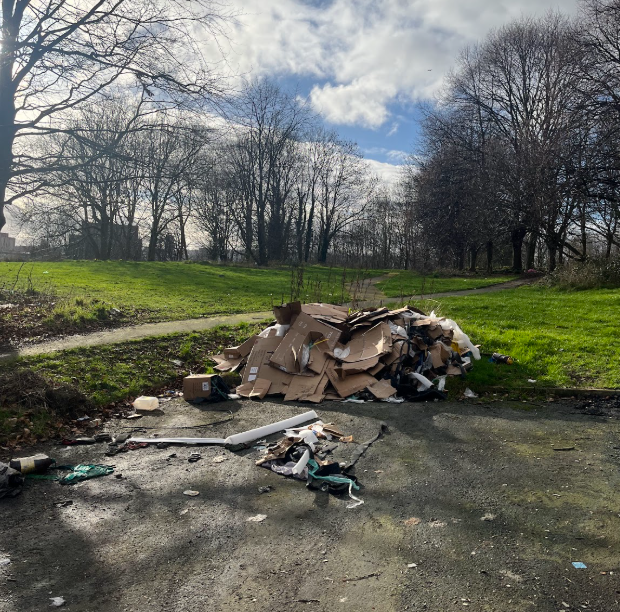
The first, and largest, fly-tipped pile, seen on arrival.
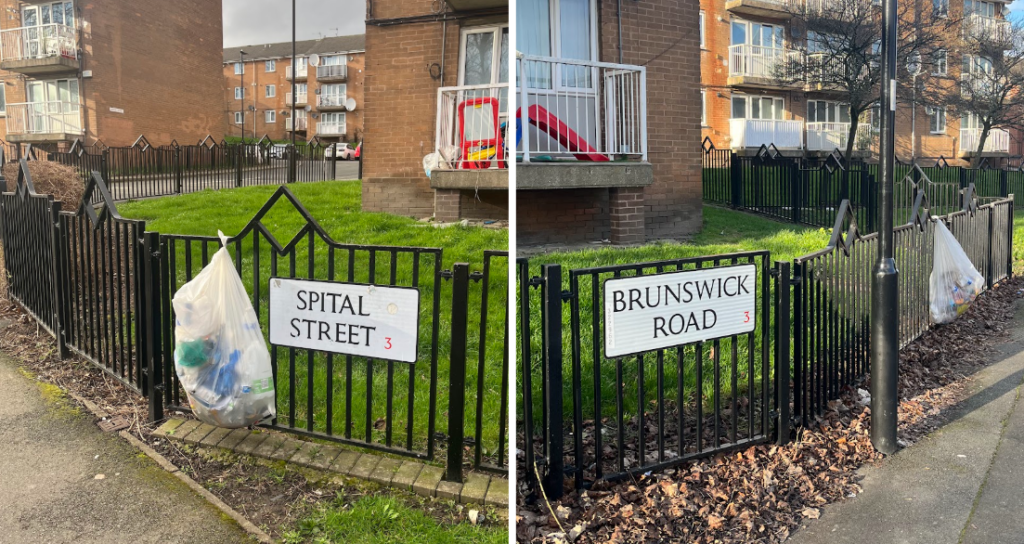
Bin bags seen to help keep rubbish off the streets.
Fire
Across the park, amongst a growing pillar of smoke, a man was seen hunched over a small fire.
Likely one of the few people to still use and enjoy the park despite its condition, Ali, who has lived on Verdon Street for two years, spoke about living with the rubbish-filled park at the end of his street.
Looking out across the view of the city from his seat on the edge of the parkland, he said: “I come here on Sundays to sit and look at the view. Sometimes I make a barbeque; sometimes I burn the rubbish. I like to keep my area clean.”
He had just phoned his friend to come and join him.
“See that pile?” Pointing to the area across from him, “I will burn that next. It wasn’t there yesterday; I think they come in the night.” When asked how the rubbish is dumped, he said: “Look, there, there”, pointing to the white van parked on the opposite side of the park, “They always dump it there.” It was by the fly-tipped pile our reporter first found when arriving. He said it has always been like this for the two years he has lived on Verdon Street.
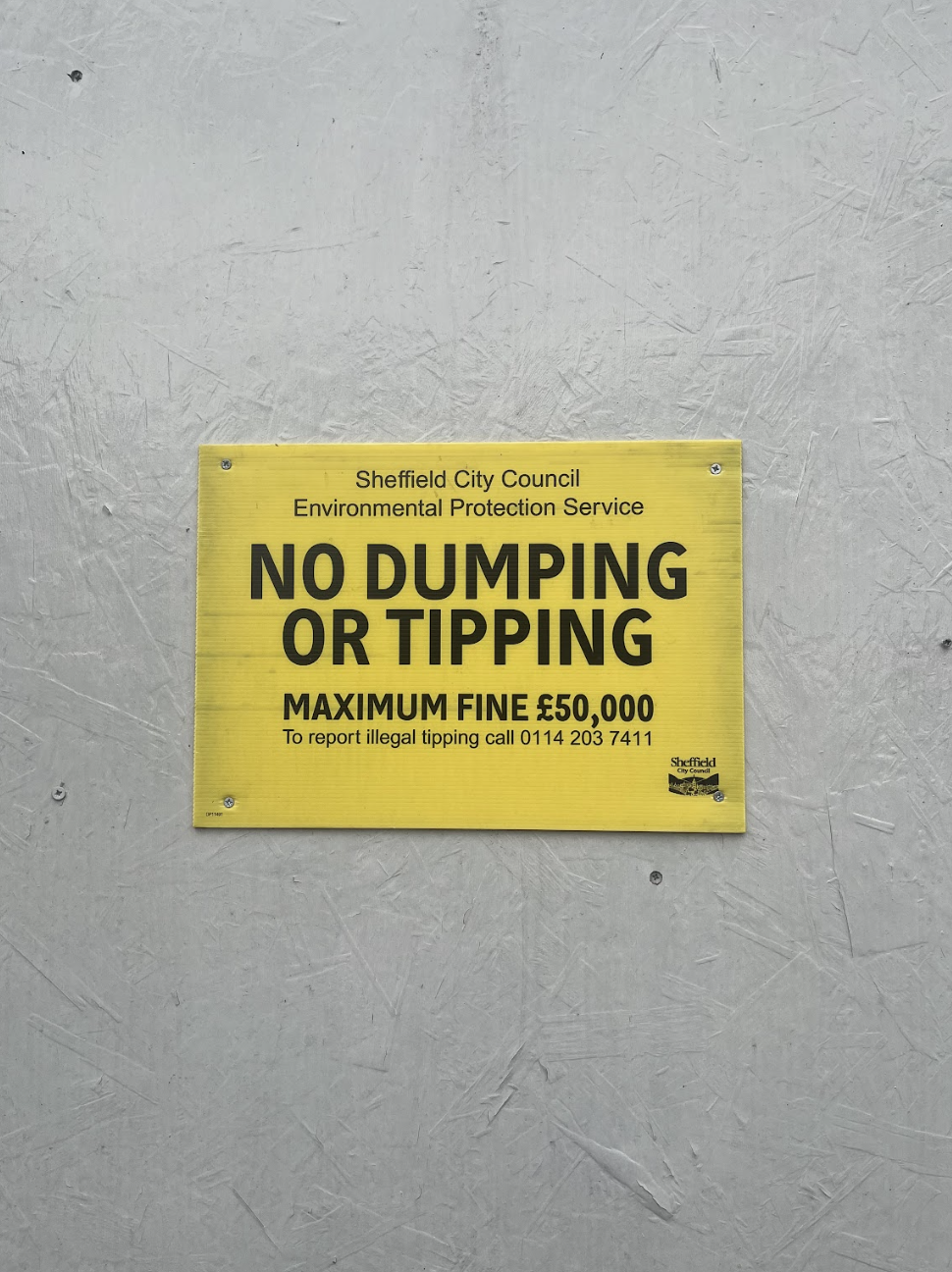
With no obvious signs of CCTV, or even posters or signs warning of punishment, the park – its sole purpose to unite the three streets together; a place for the residents to use and enjoy – unites them only under the same, subjugating title as Sheffield’s “most targeted streets”.
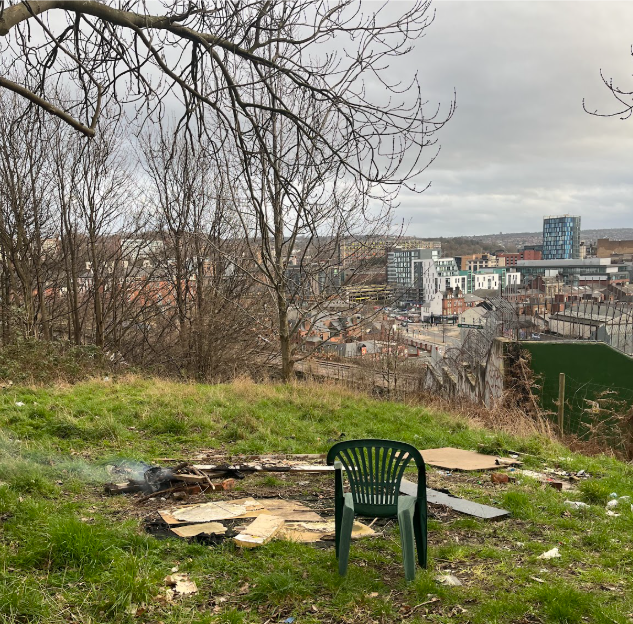
Ali’s seat by the edge of the park. He uses rubbish to keep his fire going.
DEFRA
The more than a decade of fly-tipping in and around the park connecting these three streets is only likely to worsen. The Department for Environment, Food & Rural Affairs (DEFRA)’s publishing of the ‘Fly-tipping statistics for England, 2024 to 2025’ on 25 February has revealed that, nationally, fly-tipping incidents have increased by 9% from 1.153 million in 2023/24, to 1.258 million in 2024/25. Meanwhile, the number of fines handed down from courts decreased by 9% from 1,378 in 2023/24 to 1,250 in 2024/25 – meaning merely 0.2% of fly-tipping incidents have resulted in court action.
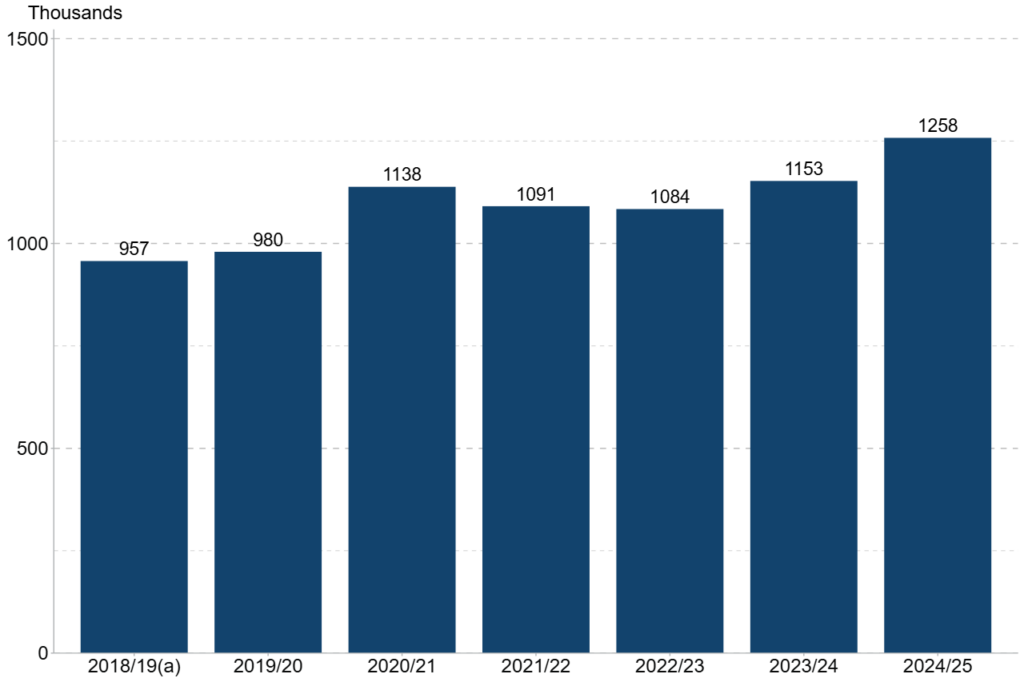
‘Total number of fly-tipping incidents in England, 2018/19 to 2024/25’.
Source: WasteDataFlow, Defra.
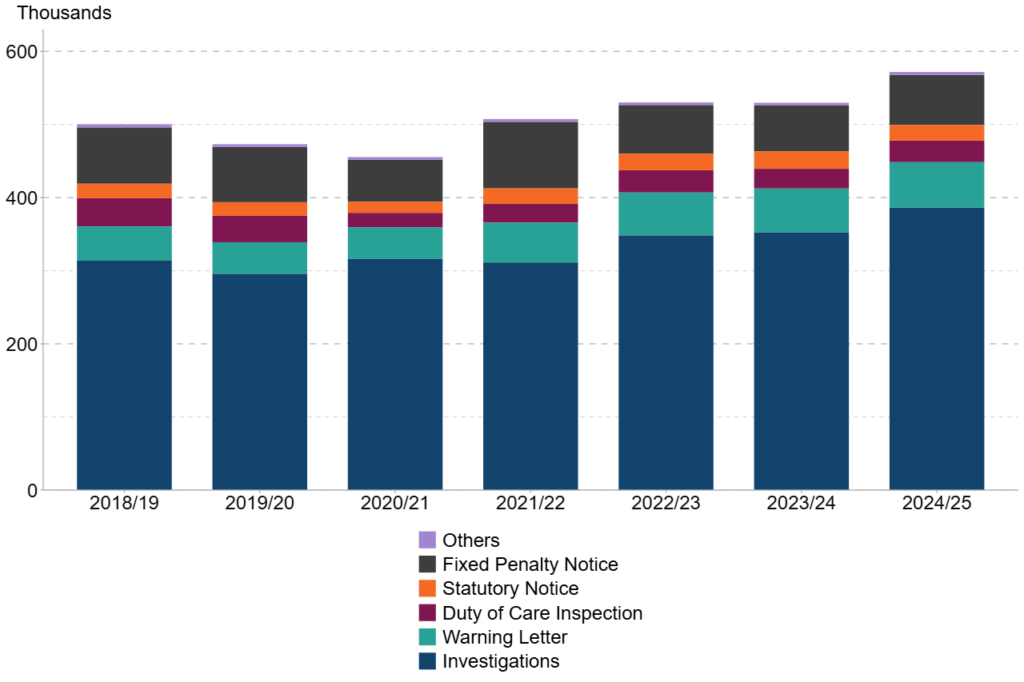
| Enforcement Action Type | 2023/24 | 2024/25 | % Change | % of Total Actions (2024/25) |
| Investigations | 353,000 | 386,000 | +10% | 68% |
| Warning letters | — | 62,000 | — | 11% |
| Duty of care inspections | 27,000 | 29,000 | +9% | 5% |
| Statutory notices | 24,000 | 21,000 | −10% | 4% |
| Total enforcement actions | 530,000 | 572,000 | +8% | 100% |
‘Fly-tipping enforcement actions in England, 2018/19 to 2024/25’.
Source: WasteDataFlow, Defra.
In their report, DEFRA states: “Fly-tipping is a crime, a significant blight on local communities and a source of environmental harm. Local authorities have a duty to clear fly-tipped material from relevant land in their areas and consequently they deal with the vast majority of fly-tipping on public land.”
This is something we all know.
Something we should not ignore, however, is when the Council fulfils this “duty to clear fly-tipped material from relevant land in their area”, but does not effectively target, deter, and prevent the “significant blight on local communities” caused when areas are repeatedly used as fly-tipping hotspots – in the case of this south Burngreave park, for over a decade.
Considering their 2025-2026 Fly Tipping Reduction Strategy states “solutions” to the “most problematic sites” will have been produced by “Spring 25”, this is an increasingly pertinent issue.
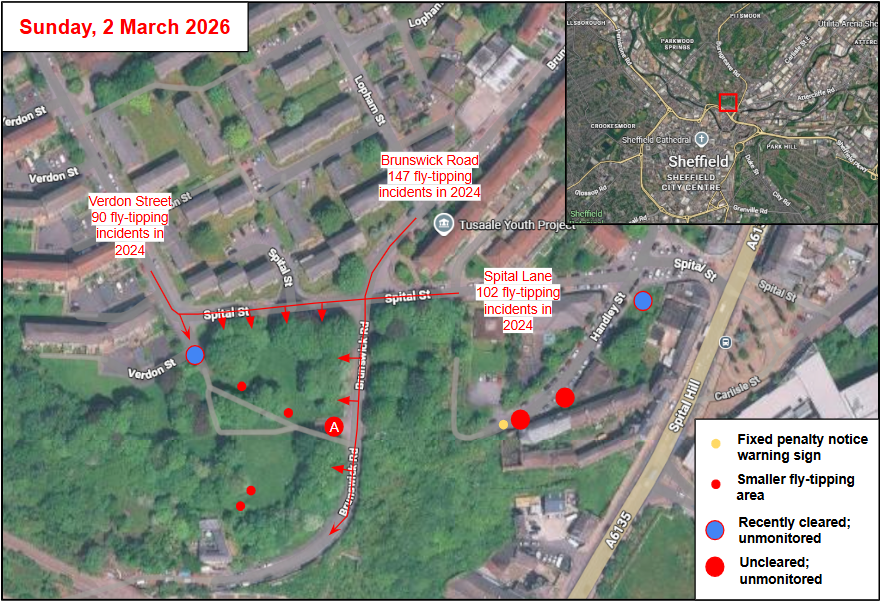
Map: The locations and findings of our investigation.
Futility
As Sheffield Wire prepared to leave, a man with a shopping bag stopped at the largest pile of fly-tipped rubbish; the one Ali had pointed to across the park – referenced as ‘A’ in the image above and pictured at the start of the article and below.
The man threw his hands at it in a gesture of irritation and annoyance; our reporter stopped, walked over, and spoke to him.
Abdullah, who walks through the park often, revealed only last week he had stopped a van from dumping on this exact spot: “I had my camera, and went up to them to say ‘look! Stop what you are doing!’ – they drove off; nothing was dumped,” he said, “But now, look, it’s all here.”
When asked if he knew who had dumped it, Abdullah said: “They must come from a shop or something, far away from here. Maybe, look at it and there will be an address.” He turned over a cardboard box previously housing a TV, and a couple of black bags rattling as if they were filled with bottles or shards of glass.
There was no address; nothing to identify the perpetrator – it is likely the first thing the criminals with any experience in the crime remove before fly-tipping their waste.
He believes it is the fact there is no CCTV in the area that is causing the issue: “If there was a camera, a big camera, they wouldn’t come – my phone camera does not stop them for long.”
It is not difficult to imagine. There was not a single sign to deter fly-tipping or warn of prosecution in the park or on the surrounding streets, and there was no obvious CCTV presence to capture and record criminals in the act.
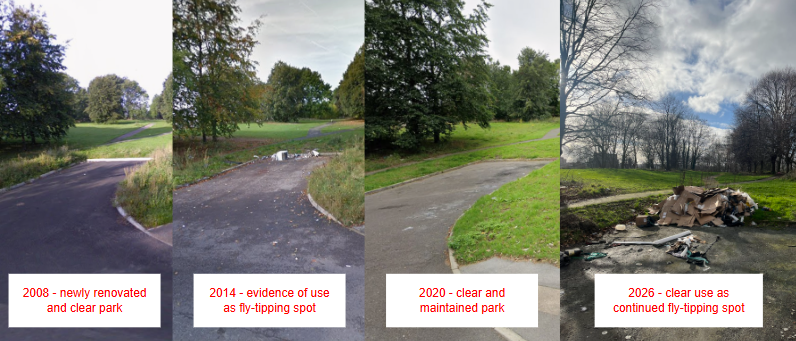
Source: Google Street View, combined with image by Author.
Authority
To understand the Council’s position, their ‘Sheffield Fly Tipping Reduction Strategy 2025-2026’ includes details of educational and awareness plans to combat fly-tipping, the awareness they have for existing hotspots, and their deterrent and preventative tactics to address them:
- “Site specific target hardening solutions eg. fencing, CCTV, road closures etc to prevent incidents.”
- “Additional CCTV units were purchased to ensure where there were hotspots which would benefit from surveillance”
The strategy continues: “Sheffield city council has a small enforcement team of officers who investigate incidents of fly tipping. A large part of their work is reactive dealing with service requests from members of the public, internal and external partner agencies/departments. Our core approach when dealing with complaints is to identify if there is any evidence and then undertake a criminal investigation.”
The glaring issue is: these hotspot tactics were not in place around Sheffield’s “most targeted street”: Brunswick Road, nor Spital Lane or Verdon Street. There was no fencing, no CCTV, and no road closures on any of these streets. The only work seen in the area was on the smaller, Handley Street, off Spital Street, where a previous fly-tipping hotspot had been fenced off; pushing a new hotspot just under the fluorescent yellow warning signs posted on the plywood wall.
Neither here nor at any other of the fly-tipping sites was there evidence of these “additional CCTV units” – visible or sign-posted. Perhaps it has been decided that Sheffield’s most fly-tipped street would not “benefit from surveillance”? If the small, reactive enforcement team are looking to conduct evidenced-based investigations into fly-tipping around the park area of Brunswick Road – where there is no clear CCTV coverage – it is no wonder that, nationally, the level of court action taken against fly-tipping incidents is at 0.2%.
Several Sheffield City Council representatives, including Councillor Safiya Saeed, the Sheffield Lord Mayor and a representative for Burngreave Ward, along with executives heading the Council’s environmental and development teams, were contacted for comment. They were asked about the Council’s commitments for the streets of Spital Lane, Brunswick Road, and Verdon Street under the ‘Sheffield Fly Tipping Reduction Strategy 2025-2026’, and the Sheffield Wire put to them comments received from residents regarding night-time fly-tipping and lack of CCTV coverage in the area.
Sheffield Wire received response from Councillor Mark Rusling, who said: “A lot of work is going into the Burngreave area to clear up and prevent fly tipping.”
It is clear more will need to be said, and more will need to be done.